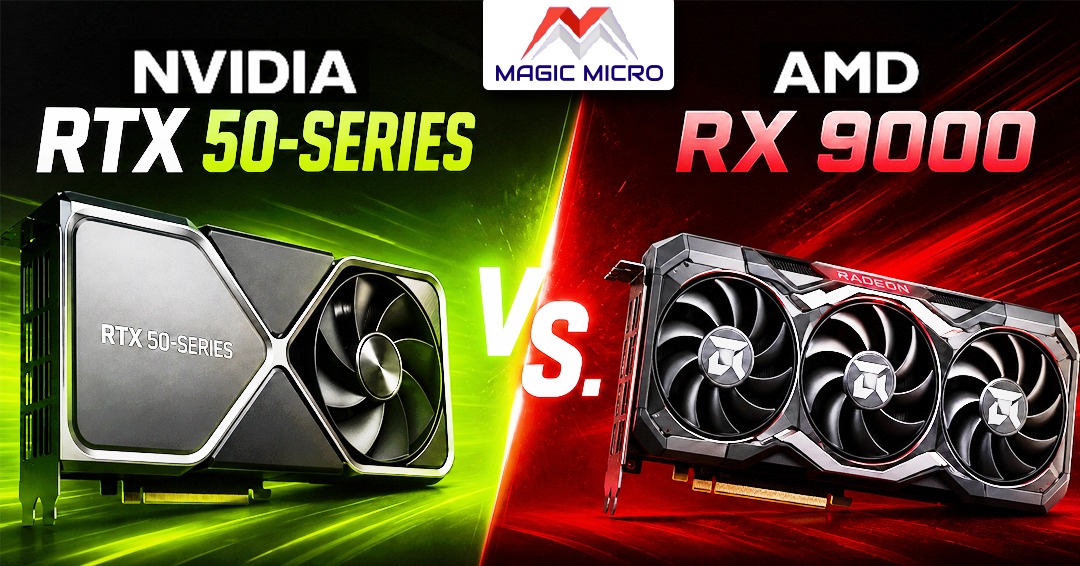
You are ready to build a PC for serious metaverse work – deeply engaging VR gaming, content creation, and exploring virtual worlds. Now you are stuck on one decision: NVIDIA or AMD?
This is not simple. Both have some good offerings and some cons. And the right choice depends on your budget and goals. At Magic Micro, we have helped countless people navigate this exact decision when building custom gaming PCs and workstations. The answer is rarely obvious. Let us make it clear for you.
What the Metaverse Actually Demands?
The metaverse isn’t like normal gaming. It’s bigger, smarter, and always live – with real-time action, AI features, realistic graphics, and massive virtual worlds. Your GPU needs to keep up with:
- High frame rates at high resolutions
- Ray tracing for realistic lighting
- Plenty of VRAM for fast loading environments
- AI acceleration for upscaling
Bottom line: metaverse-ready means intelligent, efficient, and forward-thinking. Not just fast.
NVIDIA RTX 50-Series: The Performance Leader
NVIDIA’s RTX 50-Series (Blackwell architecture) pushes boundaries with meaningful improvements in ray tracing and AI capabilities. The key advantage is DLSS 4 – AI technology that boosts your FPS without sacrificing visuals. In metaverse environments with complex lighting, this is a genuine 2-3x performance multiplier.
The 4th-generation RT cores give photorealistic lighting, reflections, and shadows with less performance penalty. This counts if visual fidelity matters.
The downsides: The catch? NVIDIA GPUs like the RTX 5090 are absolute power-consuming systems – expensive, heat up fast & need strong cooling to perform at their best.
Choose NVIDIA if you’re a content creator, want maximum VR performance, can afford the price tag & planning to keep the GPU for 5+ years.
AMD RX 9000: The Practical Alternative
AMD is all about raw power, better value & more performance for your money. The RX 9000 series is a huge step up from older AMD GPUs, especially in ray tracing performance. You get genuinely competitive performance without NVIDIA’s advanced AI features.
AMD excels in generosity with VRAM and efficiency. Flagship models come with 16 GB standard – some push 24 GB. For metaverse environments loading massive textures, this matters. Lower power consumption means silent systems and lower electricity costs.
Pricing is honest: $600-$900 for strong cards versus $1,200+ for NVIDIA equivalents. AMD’s FSR 4 upscaling is less aggressive than DLSS 4 but still excellent for gaming.
Choose AMD if: you want strong performance without premium pricing, value efficiency over cutting-edge features, run multiple displays, or prefer open standards.
The Head-to-Head Breakdown
Ray Tracing: NVIDIA wins. If exploring metaverse spaces with sophisticated lighting matters, NVIDIA delivers noticeably better results. AMD has closed the gap, but NVIDIA leads.
VRAM: AMD offers more VRAM at comparable prices. NVIDIA’s GDDR7 memory is faster, but for most metaverse work, AMD’s generous allocation is the practical advantage.
VR Performance: Both excel. NVIDIA edges ahead in ultra-high-resolution VR, but AMD handles standard VR headsets smoothly.
AI Features: NVIDIA’s advantage is Tensor cores and DLSS (more sophisticated). AMD’s approach is straightforward but equally effective for gaming.
Cost Per Performance: AMD wins decisively. You get 85-90% of NVIDIA’s performance for 50-60% of the price.
Long-term Value: NVIDIA’s AI leadership might matter more in 2-3 years as metaverse platforms evolve. But AMD’s current value means fewer regrets if you want to enjoy virtual worlds now.
Your Whole System Matters
Here’s what people miss: they fixate on GPU specs and ignore everything else.
Dropping an RTX 5090 into a PC with a weak CPU, poor power supply, or mediocre cooling is like putting a race car engine in a rusty sedan. For metaverse work, you need:
- A CPU that keeps up (Ryzen 7 or Intel Core i7 minimum)
- Fast NVMe SSD storage
- Adequate power supply (850W minimum, 1000W ideal for high-end builds)
- Good cooling solution
- Enough RAM (32 GB standard, 64 GB for creation work)
A balanced system performs dramatically better than specs alone suggest.
The Real Answer
1. Get NVIDIA if: you want the absolute best experience and plan to use your PC for gaming and professional metaverse development. The RTX 5080 is the sweet spot – serious performance without extreme cost.
2. Get AMD if: you want excellent performance without premium pricing, value efficiency over cutting-edge features, or build on a tighter budget. The RX 9070 XT delivers impressive results for around $700.
This is where working with a top custom PC building company makes a difference. At Magic Micro, we help build custom gaming PCs and workstations tailored to your actual needs – not just components everyone else buys. Whether you want a gaming setup or a hybrid system for VR and professional work, the right configuration depends on how you’ll actually use it.
Final Thoughts:
The metaverse is still evolving. Neither NVIDIA nor AMD is wrong – they’re different approaches to the same problem.
- NVIDIA leads in innovation and raw performance
- AMD leads in practical value and efficiency
- Both deliver smooth, immersive experiences.
Whatever you choose, ensure your whole system supports it. A balanced, well-thought-out build beats a star GPU surrounded by weak components every time.
Start with your budget, then work backwards. Choose your GPU based on that budget and your actual use case – not marketing hype. If you’re unsure about any part, Magic Micro is here to help you build the right custom gaming PCs or workstations.
Your ideal metaverse machine probably isn’t someone else’s. And that’s fine.
Frequently Asked Questions (FAQs):
1. What is the main difference between NVIDIA RTX 50-Series and AMD RX 9000 GPUs?
NVIDIA RTX 50-Series GPUs focus on advanced AI features, stronger ray tracing, and premium performance, while AMD RX 9000 GPUs emphasize value, efficiency, and competitive gaming performance at a lower price.
2. Which GPU is better for metaverse gaming and VR experiences?
Both NVIDIA and AMD GPUs perform well for metaverse gaming and VR. NVIDIA has an advantage in ultra-high-resolution VR and AI-powered enhancements, while AMD offers smooth VR performance with better value for most users.
3. Does NVIDIA offer better ray tracing performance than AMD?
Yes, NVIDIA currently leads in ray tracing performance. RTX 50-Series GPUs provide more realistic lighting, reflections, and shadows with better optimization for demanding games and virtual environments.
4. Why is DLSS 4 important for metaverse environments?
DLSS 4 uses AI to improve frame rates and visual quality at the same time. This helps metaverse applications run more smoothly while maintaining realistic graphics and immersive experiences.
5. Is AMD RX 9000 a good choice for custom gaming PCs and workstations?
Yes, AMD RX 9000 GPUs are an excellent choice for custom gaming PCs and workstations because they deliver strong performance, generous VRAM, and better cost efficiency for gaming and creative workloads.
6. Which GPU provides better value for money: NVIDIA or AMD?
AMD generally offers better price-to-performance value. Users can get high-end gaming and VR performance at a significantly lower cost compared to similar NVIDIA GPUs.
7. How much VRAM do I need for metaverse gaming and content creation?
For modern metaverse gaming and VR applications, 16 GB of VRAM is recommended. Professional content creation and large virtual environments may benefit from 32 GB VRAM or higher.
8. Are AMD GPUs more power-efficient than NVIDIA GPUs?
In many cases, yes. AMD RX 9000 GPUs typically consume less power than NVIDIA RTX 50-Series cards, resulting in cooler and quieter systems with lower electricity usage.
9. What power supply is recommended for high-end gaming PCs with RTX 5090 or RX 9070 XT?
A minimum 850W power supply is recommended for high-end systems, while 1000W is ideal for builds using flagship GPUs like the RTX 5090 and multiple high-performance components.
10. Why should I choose a custom gaming PC or workstation from Magic Micro?
Magic Micro builds custom gaming PCs and workstations tailored to specific performance needs, helping users get the right balance of GPU power, cooling, storage, and overall system performance for gaming, VR, and professional applications.