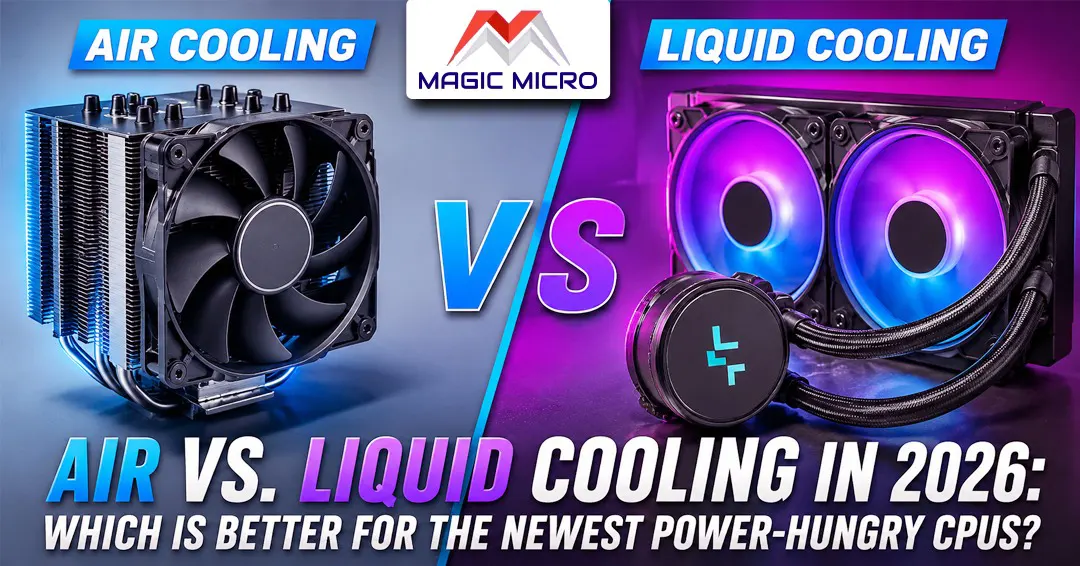
Your CPU is basically a tiny space heater now. That’s not an insult – it’s just physics. The newest chips push more power through a smaller die than ever, and your cooler has to keep up, or you’re throttling before you even load your game.
So, which setup wins in 2026: air or liquid? Let’s break it down like we’re standing in front of an open case together.
What’s Actually Changed With These New Chips
A few years ago, a solid tower cooler handled almost anything you threw at it. Not anymore. Flagship CPUs today routinely push past 250W under load, and some workstation chips blow way past that when you’re rendering or compiling.
Higher TDP numbers mean more heat concentrated in a smaller space. Push a chip too hard without enough cooling, and it hits thermal throttling the processor automatically slows itself down to avoid damage. Your expensive CPU starts acting like a budget one. Not fun.
This is the real reason the cooling conversation got loud again. It’s not hype. It’s watts.
The Case for Air Cooling
Air cooling isn’t dead. Not even close.
Why It Still Wins for a Lot of Builders
Air coolers are simple. No pump, no tubing, nothing to leak on your $2,000 GPU. A quality tower cooler with a couple of fans handles mid-range and even some high-end chips just fine, and it’ll outlive your entire build without a second thought.
They’re also cheaper, quieter at idle, and dead simple to install. If you’re not chasing every last degree, air is the low-drama choice.
Where It Starts to Struggle
Once you get into the highest-wattage CPUs – the ones built for heavy multitasking, streaming while gaming, or serious workstation loads – air starts running out of headroom. You can still use it. You’ll just be capping performance to stay in a safe temperature range, which kind of defeats the point of buying a flagship chip.
The Case for Liquid Cooling
This is where liquid earns its reputation.
AIOs vs. Custom Loops
An all-in-one liquid cooler moves heat away from the CPU faster than air can manage, especially under sustained loads. A 240mm or 360mm AIO is basically the default now for anyone building a serious rig. Custom loops go even further – more surface area, better sustained performance, and honestly, they look incredible behind tempered glass.
The core idea behind liquid cooling is simple: liquid moves heat away from the source much faster than air alone, so your CPU stays cooler under sustained, heavy loads.
Why It Matters More in 2026
With today’s power-hungry chips, liquid cooling isn’t just a flex anymore. For anything pushing serious sustained wattage, it’s close to necessary if you want full performance without throttling. That’s especially true for rendering, streaming, or running multiple demanding apps at once.
So Which One Should You Actually Buy?
Here’s the honest answer: it depends on what you’re building.
Gaming on a mid-tier chip with occasional heavy sessions? A good air cooler will treat you right for years. Building something closer to a workstation, or running a top-tier CPU flat out for hours at a time? Liquid is the smarter call.
At Magic Micro, we spec cooling based on the actual chip and actual workload – not just what looks good in a spec sheet. We’ve built custom gaming PCs and workstations for everyone from casual streamers to studios running render farms, and the cooling decision changes every single time depending on what the machine needs to do.
If you’re not sure which route fits your build, that’s genuinely fine – most people aren’t. Browse our prebuilt configurations to see how we pair coolers with specific CPUs, or just reach out, and we’ll walk you through it.
The Bottom Line
Air cooling isn’t obsolete. Liquid isn’t automatically better. What matters is matching the cooler to the chip and the workload in front of you.
That’s the difference between a computer that just runs and one that actually performs the way it’s supposed to. It’s also why builders keep coming back to Magic Micro, a top custom PC building company, instead of guessing at parts themselves – getting this match right the first time saves you money, noise, and a whole lot of frustration down the road. Stop thinking too much, call us or contact us to get assistance for all your queries!
Frequently Asked Questions(FAQ):
1. Is air cooling enough for modern CPUs?
Yes, a high-quality air cooler is sufficient for most mid-range and many high-end CPUs used for gaming.
2. Is liquid cooling better than air cooling?
Liquid cooling generally offers better thermal performance for high-end CPUs under heavy workloads.
3. Do I need liquid cooling for gaming?
Not always. Most gamers can achieve excellent performance with a quality air cooler.
4. Which CPUs benefit most from liquid cooling?
Flagship processors with high power consumption benefit the most from liquid cooling.
5. What is thermal throttling?
Thermal throttling is when a CPU reduces its performance to prevent overheating.
6. Are AIO liquid coolers reliable?
Yes, modern all-in-one (AIO) liquid coolers are designed to be reliable and require minimal maintenance.
7. Does liquid cooling improve gaming FPS?
Liquid cooling doesn’t directly increase FPS but helps maintain peak CPU performance during long gaming sessions.
8. Can air coolers handle high-TDP processors?
Some premium air coolers can, but they may struggle with sustained heavy workloads on the highest-TDP CPUs.
9. What’s the difference between an AIO and a custom loop?
An AIO is a sealed, maintenance-free liquid cooler, while a custom loop is user-built for maximum cooling performance and customization.
10. Should I choose air or liquid cooling in 2026?
Air cooling is ideal for mainstream gaming builds, while liquid cooling is recommended for flagship CPUs and demanding workloads.