Something shifted in the gaming hardware market this year that most buyers did not see coming. Custom gaming PCs and workstations that were comfortably priced six months ago have crept up noticeably – and the increases are not random. There are specific, real reasons behind what is happening, and understanding them helps you make a smarter buying decision right now rather than waiting for prices that may not come down soon.
The Real Reason Prices Are Up: It Starts with Memory
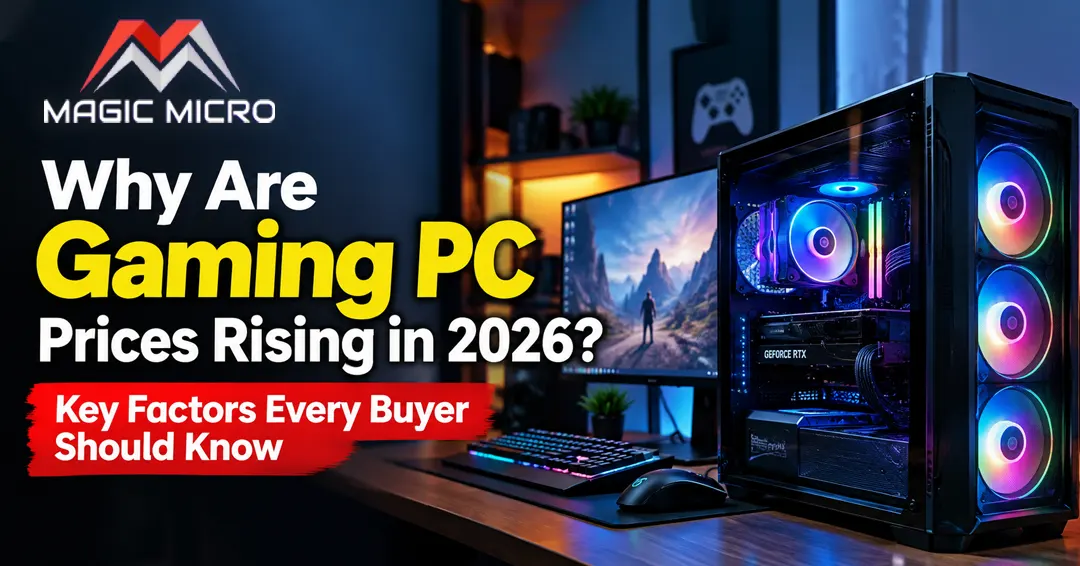
The single biggest driver of gaming PC price increases in 2026 is memory – specifically GDDR7 and GDDR6 VRAM used in graphics cards, plus DDR5 system RAM.
In July 2026, multiple industry reports confirmed that NVIDIA notified its board partners of price increases on both GDDR7 and GDDR6 memory kits. A 3 GB GDDR7 module reportedly costs $60–70, roughly triple the ~$20 price of a standard 2 GB module, and analysts expect finished GPU prices to rise 20–30% as those costs pass through.
That is not a small movement. A 20–30% increase on GPU prices alone changes the math on every tier of gaming PC build. And the GPU is not the only component catching price increases.
A prebuilt gaming desktop bundles a GPU, CPU, RAM, storage, and a power supply – and at least three of those five components (GPU, RAM, and often storage) have been caught up in the same memory shortage simultaneously this year. That compounding effect is a big part of why prebuilt PC pricing has drifted upward across the board in 2026.
Why Is Memory So Expensive Right Now?
AI Data Centers Are Competing with Consumers for the Same Supply
According to Best Buy Canada’s PC component pricing analysis, as companies purchase large volumes of GPUs, memory, and storage for AI clusters, fewer components remain available for consumer markets – which pushes retail prices higher. Graphics cards and DRAM memory are the most directly affected components.
This is the root of the problem. The AI industry has not just grown – it has absorbed memory supply at a scale that consumer hardware manufacturers cannot easily compete with. NVIDIA and AMD are selling enormous quantities of high-bandwidth memory to data center customers at prices that consumer GPU production simply cannot match.
DRAM Manufacturers Shifted Production Away From Consumer Products
Over 2025, hyperscalers signed enormous long-term contracts for high-bandwidth and server memory, and the big three DRAM manufacturers responded by converting consumer-oriented fab lines to data center products. By late 2025, contract DRAM pricing had turned sharply upward, and by mid-2026 the cumulative rise reached roughly 170%.
DDR5 consumer RAM, following the same supply pressure, means system RAM prices have climbed alongside GPU VRAM. Both hit buyers at the same time.
Supply Growth Is Not Keeping Up With Demand
DRAM and NAND supply growth is expected to come in below historical norms this year. With demand accelerating and supply growth constrained, price is the only release valve.
Intel’s CEO has publicly stated that meaningful relief from these shortages may not arrive until 2028. That is a long window to wait before prices normalize.
How Much Are PC Prices Actually Rising?
The numbers are confirmed by multiple sources.
Major PC vendors, including Lenovo, Dell, HP, Acer, and ASUS, have warned clients of 15–20% price hikes and contract resets for systems shipping in the second half of 2026. IDC projects overall PC prices to rise by 4% to 8% in 2026 due to memory and storage shortages.
That 4–8% figure is an average across all PC categories. Gaming-specific hardware – where GPU VRAM and high-speed RAM are central components – sits at the higher end of that range or beyond it.
NVIDIA and AMD have both pushed through phased price increases in 2026. Every one of those moves traces back to the same root cause: AI data centers outbidding consumer hardware demand for the same memory supply.
What This Means for Buyers Right Now
Waiting Does Not Help in the Short Term
Desktop builders face the same buy-now math – the GDDR6/GDDR7 kit increases apply to the entire GeForce lineup, and analysts expect desktop graphics card prices to rise 20–30% as costs pass through.
The realistic window for lower pricing is not weeks away – it is 2027 at the earliest based on current supply chain projections. Buyers who delay purchasing in anticipation of a price drop may end up paying more for the same hardware six months from now.
Prioritize VRAM and RAM Capacity Over Everything Else
According to HP’s component pricing guide, focus on matching specifications to actual use cases and maintaining forward visibility for planned purchases. The practical translation for gaming buyers: GPU VRAM (12 GB or more for 1440p gaming), system RAM (32 GB minimum), and SSD capacity (1 TB minimum) are the specs most exposed to both price increases and configuration cuts.
Buy the right VRAM capacity now. An 8 GB VRAM card bought to save money today is the spec most likely to feel underpowered in 2027, when prices will likely be higher and the performance gap will have widened further.
Budget Cuts Hit the Wrong Components in Generic Prebuilts
When manufacturers feel price pressure, they reduce specs to hold price points. RAM gets cut from 32 GB to 16 GB. Storage drops from 1 TB to 512 GB. These are the components most affected by the memory shortage – and they are exactly the ones where buyers should not accept cuts. Watch spec sheets carefully. A machine that holds GPU tier but reduces RAM capacity to stay at a price point is making a trade-off that hurts long-term usability.
How to Buy Smart in a Rising Price Environment?
Working with a top custom PC building company gives you control over where the budget goes – GPU VRAM, RAM capacity, and NVMe storage are all configurable to your actual priorities rather than a manufacturer’s margin calculation.
At Magic Micro, every build is fully customizable. You decide what gets prioritized based on how you actually use the machine. Browse the gaming PC catalog to see current configurations across every tier, all priced at current market rates with no hidden component substitutions.
If budget is the immediate consideration, Bread Pay financing splits the cost into manageable monthly payments – locking in current pricing rather than paying more for the same spec in 2027. And if you want a specific build put together around your resolution target and game library, the build team handles that directly.
For a closer look at how RAM capacity decisions affect real-world gaming performance and why 32 GB is the right call in this environment, the How Much RAM Do Gaming PCs Really Need? guide covers every scenario in plain terms.
Frequently Asked Questions (FAQ)
1. Why are gaming PC prices going up in 2026?
Three factors are driving it simultaneously: AI data centers buying GPU memory in bulk, DRAM manufacturers shifting production capacity toward server memory at the expense of consumer products, and tariff pressures adding cost at the import level. GPU prices are projected to rise 20–30%, RAM prices have already climbed significantly, and the combined effect has pushed completed gaming PC prices up across every tier.
2. Will gaming PC prices come down in 2026?
Not significantly. Intel’s CEO has indicated that supply chain normalization may not arrive until 2028. Analysts project that Q3 2026 will see DRAM prices continue rising 13–18% quarter-over-quarter before any deceleration. Waiting for meaningful price relief in the near term is unlikely to pay off.
3. Which PC components are most affected by price increases in 2026?
GPU VRAM (GDDR7 and GDDR6), DDR5 system RAM, and NAND flash storage are the three components most directly impacted. GPU prices have risen 20–30% from kit cost increases alone. DDR5 pricing has climbed roughly 40% above 2025 levels. SSD pricing has increased too, though less dramatically than RAM.
4. Is now a good time to buy a gaming PC?
Yes – relative to what prices are projected to be in 6–12 months. Current inventory reflects older, lower memory contract pricing in many cases. As those contracts roll over to 2026 pricing, finished system costs will increase further. Buying now locks in current pricing before the next round of increases passes through to retail.
5. Should I buy a gaming PC with 16 GB or 32 GB RAM given rising prices?
32 GB now rather than 16 GB and upgrading later. The price difference between 16 GB and 32 GB is smaller today than it will be once RAM prices fully reflect 2026 supply conditions. Buying the right capacity upfront avoids paying a premium for the upgrade when prices are higher.
6. Why is GPU VRAM specifically getting more expensive?
NVIDIA notified board partners of GDDR7 and GDDR6 kit price increases in July 2026, citing the global shortage of GDDR memory. The root cause is AI data centers purchasing memory in bulk at prices that crowd out consumer GPU production. A 3 GB GDDR7 module now costs roughly three times what a comparable standard module cost previously.
7. Are budget gaming PCs still worth buying in 2026?
With the right spec priorities, yes. The risk in the current market is manufacturers cutting RAM capacity or VRAM tier to hold a price point. A budget build with the right GPU VRAM (12 GB minimum), 16 GB DDR5 in dual channel, and an NVMe SSD is still solid value. A budget build where RAM has been cut to 8 GB to compensate for GPU cost increases is not.
8. How do tariffs affect gaming PC prices?
Tariffs on imported components add cost at the point of entry that manufacturers pass through to finished products. Analysis from IDC cited potential 10%+ price increases on affected products from tariff exposure alone – on top of memory shortage-driven increases. The two pressures compound rather than offset each other.
9. Is it better to buy a prebuilt or build your own given rising component prices?
In the current market, a quality prebuilt from a reputable builder can offer better value than self-sourcing because the builder locked in component pricing at earlier contract rates. Generic prebuilts from volume manufacturers carry more risk – they are more likely to cut specs quietly to hold price points. Custom-configured prebuilts where you control what gets prioritized give the best of both options.
10. When will gaming PC prices normalize?
Current supply chain projections suggest meaningful normalization is unlikely before late 2027. Intel has publicly indicated the shortage may persist until 2028. The AI demand driving memory consumption is not slowing – if anything, it is accelerating. Buyers planning on waiting for a return to 2024 pricing levels should factor a 2–3 year horizon into that expectation.