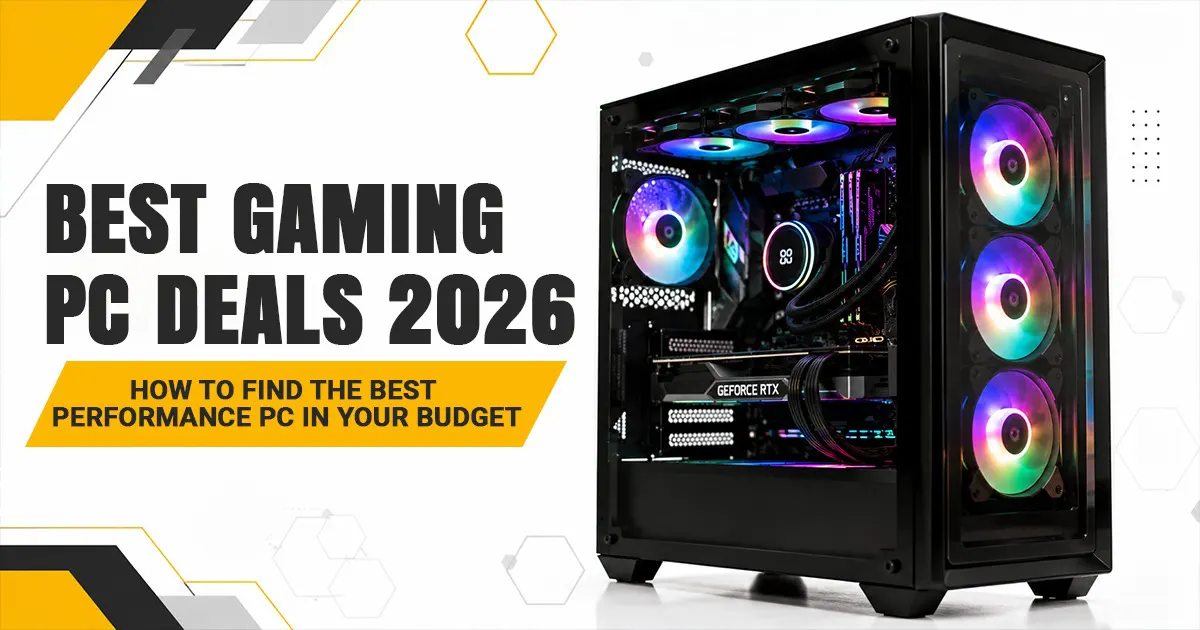
Finding a great gaming PC deal in 2026 is not about finding the cheapest price tag.
It is about finding the right performance for what you actually do – at a price that does not include paying for specs you will never use. That distinction matters more this year than it has in a long time, because the gap between tiers has shifted considerably with new GPU generations hitting the market.
Whether you are a first-time buyer or upgrading from an older system, this guide walks through what a good deal actually looks like at each budget level – and where most people go wrong when shopping for custom gaming PCs and workstations in 2026.
Why 2026 Is a Good Time to Buy?
Two things happened this year that make the gaming PC market genuinely favorable for buyers.
First, NVIDIA’s RTX 50 Blackwell series brought DLSS 4 with Multi Frame Generation to mainstream price points for the first time. The RTX 5060 Ti 16GB delivers strong 1440p performance with DLSS 4 Multi Frame Generation support and is available from around $429. That is a significant capability at a price that would have bought a mid-range card a generation ago.
Second, DDR5 RAM prices dropped considerably. DDR5 memory has become standard even at the entry level, which means budget builds now come with the right memory platform without paying a premium for it.
The challenge in 2026 is not finding capable hardware. It is avoiding the trap of overspending on specs that your monitor and game library cannot actually use.
How to Spot a Real Deal vs a Marketing Number?
Before diving into budget tiers, here are the signs that separate a genuine deal from a machine that looks good on a spec sheet but underdelivers in real use.
Good Signs:
- GPU matched to the target resolution (1080p, 1440p, or 4K)
- 16 GB DDR5 minimum – ideally 32 GB
- PCIe Gen 4 NVMe SSD as the primary drive
- Quality PSU from a reputable brand with proper wattage headroom
- CPU with at least 6 cores on a current-generation platform
Warning Signs:
- Flagship GPU paired with a weak CPU – creates a bottleneck that cuts into real performance
- 8 GB VRAM in 2026 – already tight in several current titles at high settings
- Generic or unbranded PSU at suspicious wattage
- Spinning hard drive as the primary storage – not acceptable in a gaming build today
- Single RAM stick instead of a matched pair – single channel kills memory bandwidth
Budget Tier 1: Under $1,000 – 1080p High Refresh Gaming
What you should expect: Stable 100–144 FPS at 1080p high to ultra settings in current titles. Strong performance in esports games like CS2 and Valorant at 200+ FPS. Manageable 1440p at medium settings with upscaling enabled.
What to look for in this range:
- RTX 5060 or RX 9060 XT GPU
- Ryzen 5 7600X or equivalent 6-core CPU
- 16 GB DDR5 dual channel
- 1 TB PCIe Gen 4 NVMe SSD
According to Tom’s Hardware’s best PC builds for gaming 2026, entry builds using current-generation mid-range GPUs handle 1080p ultra settings averaging well over 60 FPS across demanding titles – a solid baseline for this budget.
Magic Micro’s gaming PCs under $1000 covers this tier with AMD Ryzen 5 based systems starting at $940, all running DDR5 and NVMe storage as standard. Every system in this range is fully customizable – adding a discrete GPU through the configurator completes the build for serious gaming.
If you want a deeper look at what this tier can actually handle at 1080p, the best custom gaming PCs builds 2026 guide for 1080p gaming blog covers real-world expectations without filler.
Budget Tier 2: $1,100–$1,800 – The Sweet Spot for Most Gamers
What you should expect: Native 1440p at high to ultra settings above 100 FPS. Ray tracing at 1440p medium with DLSS Quality enabled. Strong performance headroom for the next three to four years.
What to look for in this range:
- RTX 5060 Ti 16 GB or RX 9070 as the GPU
- Ryzen 7 7700X or Core i7-14700K CPU
- 32 GB DDR5-6000 dual channel
- 1–2 TB PCIe Gen 4 NVMe
This is where the best deals live in 2026. The RTX 5060 Ti 16GB is the best value GPU for builds in this range – it delivers strong 1440p performance with DLSS 4 Multi Frame Generation support. The 16 GB VRAM version is the one worth targeting – the 8 GB variant costs less but runs out of headroom faster than most buyers expect.
32 GB of RAM is the right call at this tier. Running OBS, Discord, Chrome & a game simultaneously uses 10–15 GB of RAM, leaving very little headroom on a 16 GB system. 32 GB eliminates that entirely.
Browse the full gaming catalog at Magic Micro to see current mid-range configurations. The AMD Ryzen 7 9800X3D Gaming System sits in the upper end of this range and is worth a close look – the 9800X3D’s 3D V-Cache architecture delivers the best gaming performance available at the consumer CPU level.
Budget Tier 3: $2,000–$3,500 – High-End Without Overspending
What you should expect: Native 4K at 60+ FPS with ray tracing. High-refresh 1440p with path tracing in supported titles. A machine that stays relevant for five or more years without a full rebuild.
What to look for in this range:
- RTX 5070 Ti or RTX 5080 GPU
- Ryzen 7 9800X3D or Core Ultra 9 285K CPU
- 32 GB DDR5-6000 minimum, 64 GB if creative work is part of the workload
- 2 TB PCIe Gen 4 NVMe
The RX 9070 XT averaged 97.5 FPS at 1440p across a 16-game rasterization test & was capable of 60 FPS at 4K – showing that the high-end mid-range in 2026 genuinely covers 4K at playable frame rates without stepping up to flagship pricing.
The trap at this tier is paying flagship prices for performance you cannot see. A $3,500 machine with an RTX 5090 pushing through a 1440p monitor delivers the same gaming experience as a $2,200 machine with an RTX 5070 Ti at the same resolution. Match the GPU to the display – not the highest spec available.
Where Most People Overspend?
Buying a gaming PC is full of easy mistakes. Here are the most common ones that cost real money without adding real performance.
Buying The Top-Tier GPU for A 1080p Monitor
The extra performance has nowhere to go. A mid-range card handles 1080p completely and the saved budget goes further elsewhere.
Ignoring DLSS and FSR When Setting the GPU Budget
These technologies change what mid-range cards can deliver. An RTX 5060 Ti at 1440p with DLSS Quality enabled outperforms what a higher-tier card from two years ago could do natively. Factor upscaling into your expectations before deciding you need the next tier up.
Cutting Corners on the PSU
A cheap power supply is the one component failure that takes everything else with it. Quality 80+ Gold from Corsair, Seasonic, or be quiet! is not optional.
Buying a Single RAM Stick
Always buy matched pairs. Single-channel RAM cuts memory bandwidth and shows up as lower frame rates and worse frame time consistency.
For a full breakdown of where budget decisions go right and wrong, the complete hardware guide covers detailed hardware information that helps you stop overspending.
Getting the Most from Up-scaling in 2026
One of the best free performance upgrades available right now is simply enabling DLSS or FSR in every supported game. DLSS 4 Multi Frame Generation generates up to three additional frames for each rendered frame, effectively quadrupling frame rates in supported games – making mid-range hardware perform well above what its raw specs suggest.
Every RTX 50 series card supports DLSS 4. AMD’s FSR 4 works across a broader range of games and is available on any GPU. Check whether your games support either technology before assuming you need more GPU power. You may already have more performance available than you think.
Working With a Top Custom PC Building Company
One of the most effective ways to get the best deal on a gaming PC is working with a top custom PC building company rather than buying a generic prebuilt. The reason is straightforward: custom-configured systems are built around your specific monitor resolution, game library & budget – not a fixed configuration designed to photograph well in a product listing.
A machine built with balanced components – GPU matched to the CPU, RAM in dual channel, PSU with proper headroom & NVMe storage – performs measurably better in daily use than a spec-sheet machine where one component was compromised to hit a price point.
Magic Micro has been building custom gaming PCs and workstations since 1997. Browse the full catalog to see current configurations across every budget tier, all fully customizable. If you want a build specked around your specific setup rather than a fixed box, the build team handles that directly. For buyers where budget is the consideration, Bread Pay and PayPal Pay Later let you split the cost into manageable monthly payments.
Frequently Asked Questions
1. What is the best gaming PC budget in 2026?
For most people gaming at 1080p to 1440p, $1,100 to $1,800 is the sweet spot. You get a current-generation GPU with enough VRAM for the next few years, a capable CPU & 32 GB DDR5 – without paying for 4K performance you are not using yet.
2. Is it better to buy a prebuilt or build your own gaming PC?
Both work well if done right. A quality custom prebuilt from an experienced builder gives you a professionally assembled, tested machine with a warranty – without the time investment of sourcing parts, building & troubleshooting yourself. Self-builds give more component control but require research and assembly time.
3. How much VRAM do I need in 2026?
16 GB VRAM is the comfortable standard for 1440p gaming. 8 GB is already running tight in several 2026 titles at high settings. For 4K with ray tracing, 16–24 GB is the practical target.
4. Does RAM speed matter for gaming?
Yes, particularly on AMD Ryzen platforms. Running a Ryzen 9800X3D with DDR5 at 4800 MHz instead of 6000 MHz leaves measurable performance behind. Always enable XMP or EXPO in BIOS after a new build.
5. Is a $1,000 gaming PC worth it in 2026?
Yes – for 1080p gaming specifically. A well-configured $1,000 machine handles current titles at high settings above 100 FPS at 1080p. The limitation is 1440p at ultra settings and anything 4K – those require stepping up the budget.
6. What GPU should I buy for 1440p gaming in 2026?
The RTX 5060 Ti 16 GB or RX 9070 XT are the best value options for 1440p in 2026. Both handle high settings above 100 FPS in most current titles and carry enough VRAM for the next few years of game releases.
7. How long will a gaming PC last before needing an upgrade?
A well-configured mid-range gaming PC built in 2026 should handle new releases comfortably for three to four years before feeling dated. Choosing the right GPU tier and pairing it with enough VRAM and RAM from the start extends that window considerably.
8. Should I buy a gaming PC now or wait for newer hardware?
If you need a machine today, buy now. Waiting for the next GPU generation is a cycle that never ends – there is always something newer coming in six to twelve months. The RTX 50 series and RX 9000 series are both current-generation hardware right now, and prices on both have settled into reasonable territory. Waiting costs you months of gaming time and rarely saves as much money as people expect.
9. What is the difference between a prebuilt gaming PC and a custom gaming PC?
A prebuilt is a fixed configuration built in bulk – same specs for every buyer regardless of their monitor, games, or use case. A custom gaming PC is built around your specific needs – your resolution target, your game library, your budget split between components.
10. Does the PC case matter for gaming performance?
More than most people think – specifically because of airflow. A case with poor ventilation causes the GPU and CPU to run hotter during gaming sessions, which leads to thermal throttling – the hardware automatically slowing itself down to manage heat. A case with proper front intake fans and rear or top exhaust keeps temperatures in check and lets components run at their rated speeds consistently.